What are the latest trends in disposable vapes? In 2026, the useful story is not simply brighter screens or higher puff-count claims. It is how product design, transparent information, and end-of-life handling are changing. Some devices now feature battery indicators, clearer e-liquid details, and more compact shapes. These are visible changes, but they do not prove better quality or lower risk. A number printed on a package is not a health measure.
Professor Linda Bauld, a public-health researcher, has put the risk distinction plainly: “Vaping is not risk-free, but it is substantially less harmful than smoking.” That perspective matters when assessing new features. This outline looks at design and technology, flavor and packaging signals, product transparency, and disposal concerns. It treats these as market developments to examine, not recommendations to buy or use. Regulations and product availability vary by location, so claims should be checked against current local guidance and reliable product information. Small details matter. A battery display may help users see charge levels, while unclear labeling can leave basic questions unanswered. Trends are not proof of safety. Some claims may also change faster than independent evidence can confirm them. That is worth questioning. The aim is a careful, adult-focused overview of what is changing, what remains uncertain, and why responsible reporting should separate product novelty from evidence.
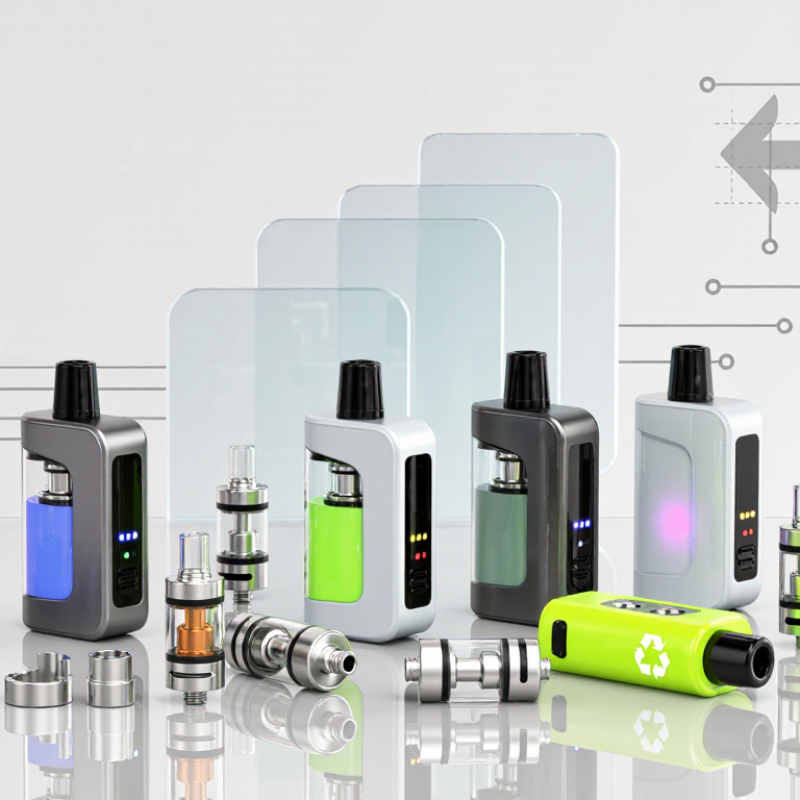
How Disposable Vapes Work: E-Liquid, Nicotine Salts, and Battery Design
Disposable vapes work through three linked parts: e-liquid, a heating coil, and a battery. A wick carries liquid to the coil, which warms it into an inhalable aerosol—not harmless water vapor. E-liquid commonly contains propylene glycol, vegetable glycerin, flavorings, and sometimes nicotine. Nicotine salts combine nicotine with an acid. They can feel smoother than some other nicotine formulations, but that does not make them safer or less addictive.
Battery design affects how long a device operates and whether it can be recharged. Some models run until their built-in battery is depleted, even if liquid remains. That is a real design inefficiency. The CDC’s 2024 National Youth Tobacco Survey reported that 55.6% of surveyed U.S. youth who currently vaped used disposable devices. This figure describes youth respondents, not the entire market. It helps explain why device design and nicotine delivery deserve careful scrutiny.
Tips: Check the product’s nicotine information and follow its handling instructions. Do not charge a damaged or unusually hot device. If you are assessing performance, remember that a smooth draw cannot reveal nicotine strength or battery condition. One limitation remains: labels and sensations alone may not tell you exactly what an aerosol contains.
Disposable Vape Design in 2026: EU E-Liquid Capacity Limits
EU rules limit nicotine-containing e-cigarette cartridges or tanks to 2 mL and refill containers to 10 mL. Nicotine concentration is capped at 20 mg/mL. These limits shape device and e-liquid design; nicotine salts are a formulation choice, while the battery powers the heating element that turns e-liquid into an inhalable aerosol.
Source: EU Tobacco Products Directive 2014/40/EU, Article 20(3)(a).
U.S. Retail Data: Disposables Reached 51.8% of E-Cigarette Sales in 2022
The 51.8% figure puts disposable devices at the center of the U.S. e-cigarette market in 2022. CDC researchers analyzed NielsenIQ retail scanner data and reported that disposables made up 51.8% of unit sales that year. The shift was substantial: their share had been 24.7% in 2019. These figures describe tracked retail sales, not every purchase channel or current 2026 demand. That distinction matters.
For retailers, the data point to a clear change in what shoppers were buying: compact, ready-to-use devices had overtaken other formats in measured sales. A small package beside a checkout counter reflects that convenience, but sales share alone cannot explain why people chose a product. Nor does it tell us whether the trend continued unchanged after 2022. The evidence is useful, not complete.
The source is Park-Lee and colleagues’ CDC report, “E-cigarette Unit Sales, by Product and Flavor Type — United States, 2019–2022,” published in MMWR. It offers a stronger basis than anecdotal store observations. Still, its data are historical. Any 2026 discussion should separate that documented 2022 milestone from newer market estimates, and avoid treating retail popularity as evidence of safety or benefit. That remains an important caveat.
2026 Product Trends: High-Puff Designs and the Push for Longer Battery Life
High-puff designs and longer battery life are prominent product-development themes for 2026. The appeal is practical: fewer interruptions and a device that can last through a full day. But a puff-count label is an estimate, not a dependable measure of real-world use. Draw length, airflow, and power settings all affect how many puffs a device delivers. The numbers need context.
Battery capacity matters. So do device size, heating power, and the amount of liquid inside. A larger battery may support longer use, but it can also make a device heavier and create more battery waste. Longer use is not automatically a benefit. The CDC and FDA’s 2024 National Youth Tobacco Survey found that 55.6% of U.S. students who currently used e-cigarettes reported using disposable devices. That figure describes surveyed youth users, not the whole population, and it is not a sales estimate. For readers assessing 2026 claims, compare the stated puff count with battery capacity and clear testing details; public data does not provide a single standardized measure for comparing every device.
What Are the Latest Disposable Vape Trends in 2026? - 2026 Product Trends: High-Puff Designs and the Push for Longer Battery Life
| Product trend |
What is changing |
Practical consideration |
Useful comparison data |
| Higher advertised puff counts |
Products increasingly emphasize larger estimated puff counts, often alongside larger e-liquid reservoirs. |
Puff-count figures are estimates, not a standardized measure of use. Actual results vary with puff duration, device output, and user behavior. |
Advertised puff count; e-liquid volume; whether the estimate’s testing method is disclosed. |
| More attention to battery runtime |
Designs intended to support more use between charges place greater emphasis on battery capacity and power management. |
Capacity alone does not determine runtime: power output, coil characteristics, and puffing patterns also affect energy use. |
Battery capacity in mAh; stated output; manufacturer-provided runtime or charging information. |
| Rechargeable disposable formats |
Some disposable designs include a rechargeable battery so the device can continue operating as its charge is depleted. |
Rechargeability does not make a device reusable indefinitely. Follow the product instructions and local rules for charging and disposal. |
Rechargeable status; charging-port type; stated charging guidance; disposal instructions. |
| Battery and e-liquid capacity considered together |
Product comparisons increasingly pair battery information with e-liquid volume and estimated puff count rather than relying on one headline number. |
A larger battery does not necessarily mean the device contains more e-liquid, and a larger reservoir does not by itself guarantee longer battery life. |
Battery capacity, e-liquid volume, advertised puff count, and whether each figure is clearly labeled. |
| Greater focus on clear specifications |
More detailed product listings can help shoppers compare capacity, charging features, nicotine concentration, and product instructions. |
Requirements differ by jurisdiction. Check local regulations and verify that product information and sales comply with them. |
Nicotine concentration and units; ingredient and warning information; applicable local compliance details. |
Note: Puff counts and battery-runtime claims are not directly comparable unless their testing conditions and measurement methods are stated.
FDA Market Snapshot: 34 E-Cigarette Products Authorized by January 2025
By January 2025, the U.S. Food and Drug Administration’s public market snapshot listed 34 authorized e-cigarette products. A limited snapshot. The figure counts specific products, not every disposable device sold or discussed online. Authorization is product-specific; it does not mean all disposable vapes are authorized or risk-free. For readers tracking trends, the key signal is a tightly defined authorized market, not a blanket endorsement of a product category.
Broader market estimates need careful reading. Grand View Research valued the global e-cigarette market at about $26.8 billion in 2024 and projected continued growth, but that estimate covers more than disposables. Not the whole category. Meanwhile, the CDC’s 2024 National Youth Tobacco Survey reported 1.63 million U.S. middle and high school students currently used e-cigarettes; disposable devices were the most commonly reported type. These figures measure different things: market revenue, authorized products, and youth use. They cannot be combined into one trend line. The distinction is easy to miss, especially when a single headline compresses a complex market.
Youth Use and Waste Risks: CDC Data and the Challenge of Single-Use Devices
In 2026, youth use and disposal remain central concerns in disposable-vape discussions. The CDC’s 2024 National Youth Tobacco Survey found that 1.63 million U.S. middle and high school students currently used e-cigarettes, or 5.9% of students. That was lower than the 2.13 million reported in 2023, but still a substantial number. Among current youth users, 55% reported using disposable devices, the most-used device type. These figures describe a public-health concern, not a reason to try vaping. (Park-Lee et al., CDC, MMWR, 2024.)
The waste is tangible: small plastic casings, metal heating parts, and lithium-ion batteries can end up in ordinary bins. Material Focus estimated that people in the UK discarded about five million disposable vapes each week in 2023, roughly four times its 2022 estimate. A discarded battery can be damaged during collection or processing, while recoverable materials are lost. That is not a small gap. Still, survey estimates are not perfect measures of every discarded device, and collection systems differ by place. The practical challenge is making safer battery handling and accessible take-back options routine, rather than treating a single-use device as ordinary litter.
Conclusion
Disposable vapes combine a prefilled e-liquid reservoir, a heating element, and a compact battery. Many use nicotine salts, which can deliver nicotine smoothly, while battery capacity and device design affect how long a product lasts. A key question for readers is what are the latest trends in disposable vapes? In 2026, product development is increasingly focused on higher-puff designs and longer battery life, reflecting demand for devices that can be used over an extended period. These features also make clear labeling and responsible product design important.
The market has changed rapidly: U.S. retail data showed disposable devices accounted for 51.8% of e-cigarette sales in 2022, while the FDA’s January 2025 snapshot listed 34 authorized e-cigarette products. At the same time, youth use remains a public-health concern, and single-use devices create waste because batteries and electronic components are discarded with the product. Understanding these trends means considering not only convenience and product performance, but also youth prevention, safe disposal, and the broader environmental impact.

 Turtle Vape